There’s a moment—rare, but unmistakable—when an advertisement doesn’t feel like an ad at all. It lingers. Maybe it makes you smile, or pause, or even feel something you weren’t expecting from a brand. And later, without trying, you remember it.
For decades, that kind of impact was considered the domain of human creativity—copywriters, designers, filmmakers shaping ideas into something meaningful. But now, there’s a new player in the room. Not a person, not quite a tool either. Something in between.
Artificial intelligence is writing scripts, generating visuals, testing variations at scale. It’s fast, efficient, and—let’s be honest—impressively capable.
Related readingWhen Customers Feel Like They Belong: The Quiet Power of Community-Led Brands
So the question isn’t whether AI can create ads. It clearly can. The real question is what happens to the human touch when it does.
The Rise of Machine-Made Messaging
AI-generated ads have grown rapidly, especially in performance marketing. Brands can now produce dozens—sometimes hundreds—of ad variations in minutes. Headlines, visuals, calls-to-action, all optimized based on data.
Platforms like Meta Ads Manager and Google Ads are already integrating AI features that suggest creatives, predict performance, and automate testing.
Related readingThe Real Value Behind Viral Clips: Understanding ROI in Short-Form Video Marketing
From a business perspective, it makes perfect sense. Faster production, lower costs, better targeting.
But efficiency isn’t the same as effectiveness. Not always.
What AI Does Exceptionally Well
Let’s give credit where it’s due. AI thrives on patterns. It analyzes what has worked before and applies those insights at scale.
Need multiple versions of a headline? Done. Want to test different color schemes or audience segments? Easy. AI doesn’t get tired, doesn’t run out of ideas—it just keeps generating.
Related readingWhy the Quality of Vinyl Matters More Than Most People Think
For brands focused on conversions—clicks, installs, purchases—this is incredibly valuable. It removes guesswork and replaces it with data-driven decisions.
In many cases, AI-generated ads outperform traditional creatives in short-term metrics. And that’s hard to ignore.
AI-generated ads vs human creativity: kaun zyada effective hai?
This is where things get interesting.
Effectiveness depends on what you’re measuring.
If the goal is immediate performance—CTR, conversions, quick wins—AI often has the edge. It’s optimized for exactly that. It learns fast, adapts faster, and doesn’t rely on intuition.
But if the goal is brand building, emotional connection, long-term recall… the equation shifts.
Human creativity brings context, nuance, and a sense of storytelling that’s difficult to replicate. It understands cultural references, humor, irony—the little things that make an ad feel alive.
AI can mimic these elements, sometimes convincingly. But mimicry isn’t the same as originality.
The Emotional Gap
There’s a subtle difference between an ad that works and an ad that resonates.
AI-generated content can be persuasive. It can follow proven structures, use compelling language, and hit the right keywords. But it doesn’t feel anything.
Humans do.
And that difference shows up in unexpected ways. A line that feels slightly off. A visual that looks perfect but lacks warmth. An idea that’s technically sound but emotionally flat.
It’s not always obvious, but it’s there.
Collaboration, Not Competition
Framing this as a battle—AI vs humans—might be missing the point.
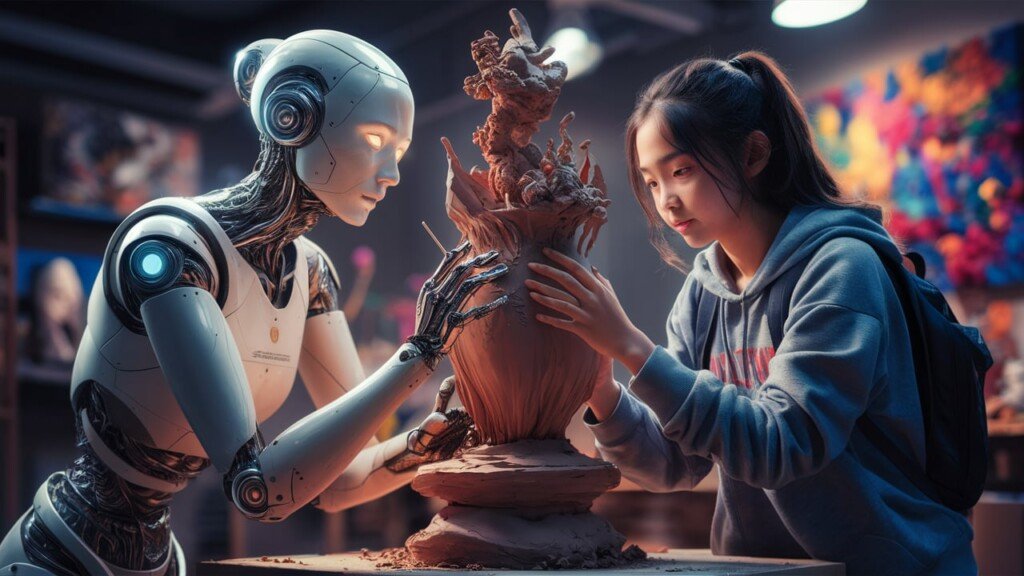
The most effective campaigns today often use both. AI handles the heavy lifting—data analysis, testing, optimization—while humans focus on the bigger picture. The idea, the story, the message behind the metrics.
Think of AI as a co-pilot. It can suggest routes, adjust speed, even correct course. But the destination? That still comes from human intent.
The Risk of Over-Reliance
There’s also a cautionary side to all this.
When brands rely too heavily on AI, there’s a risk of homogenization. Ads start to look and sound the same. Safe, predictable, optimized—but not memorable.
Creativity, by its nature, involves risk. It breaks patterns instead of following them. And that’s something AI, trained on existing data, struggles with.
If everything is optimized, nothing stands out.
What the Future Might Look Like
Looking ahead, it’s unlikely that AI will replace human creativity entirely. But it will continue to reshape how creative work is done.
We might see smaller teams producing more content. Faster iteration cycles. Greater emphasis on strategy and storytelling, with execution increasingly supported by machines.
The role of the creative professional could evolve—from creator to curator, from maker to thinker.
And that’s not necessarily a bad thing.
Final Thoughts
At the end of the day, advertising isn’t just about selling products. It’s about connecting with people.
AI can help us do that more efficiently. It can refine, optimize, and scale ideas in ways we couldn’t before.
But the spark—the thing that makes an ad feel human—that still comes from us.
Maybe the future isn’t about choosing between AI and creativity. Maybe it’s about learning how to let them work together, without losing what makes each one valuable.
Because in a world full of content, the ads we remember are rarely the ones that were just… effective. They’re the ones that felt real.