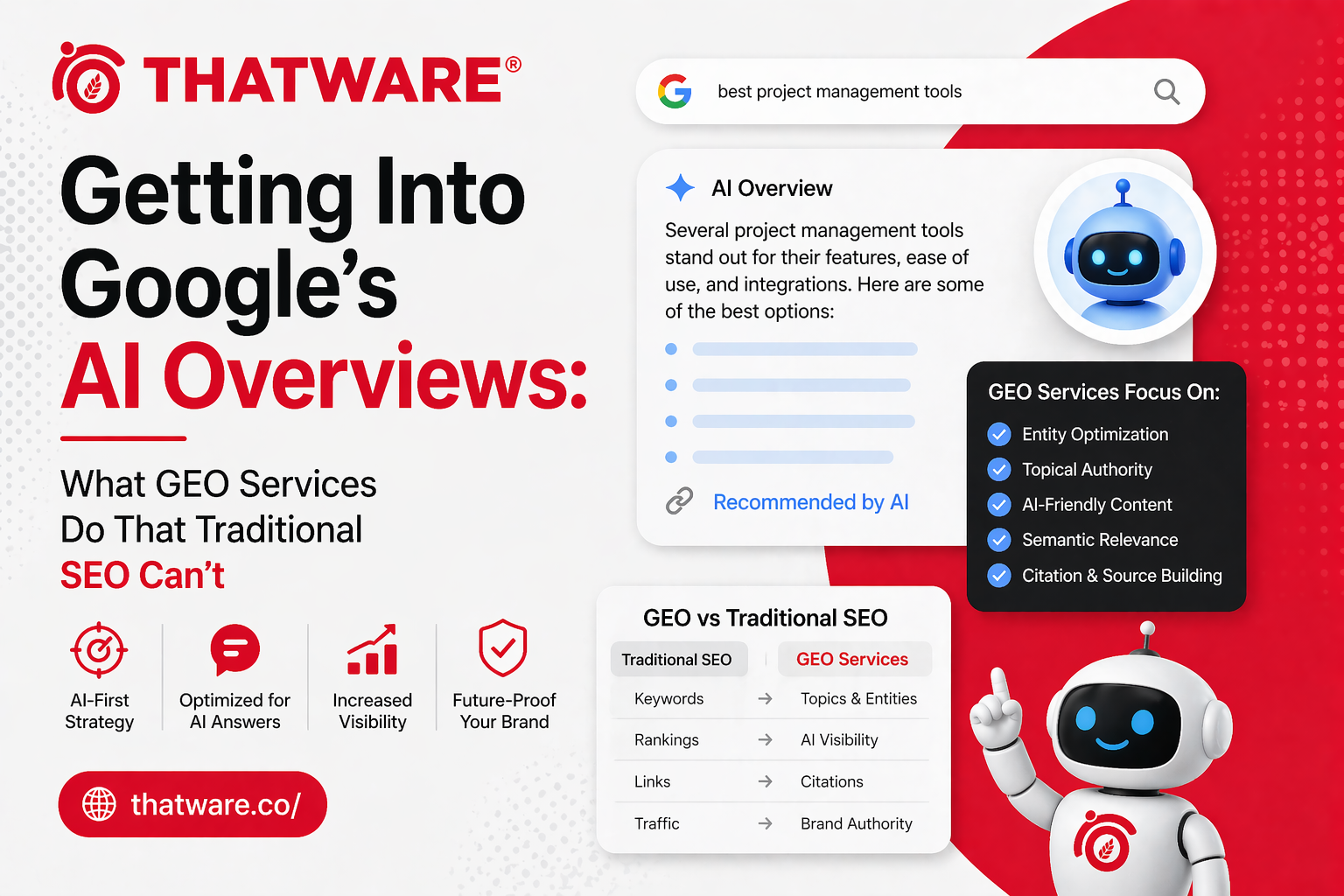
A while back, Google quietly changed the top of the search results page for a large portion of queries. Instead of showing you a list of pages and letting you choose, it started generating a synthesized answer from multiple sources and presenting it before any organic results. They called it AI Overviews, and depending on who you ask, it either represents the future of search or the thing that’s been eating organic traffic for the past year.
Both things can be true simultaneously.
AI Overviews are real, they’re here for most informational and research queries, and they’re changing the traffic distribution from search in ways that SEO strategies haven’t fully adapted to yet. Getting featured in an AI Overview is genuinely valuable: your content or brand appears at the top of the results page, cited as a source in the synthesized answer, before any organic links.
Not getting featured often means getting less traffic even when you rank well, because the overview satisfies the query before the user gets to your listing.
Related readingWhen Reality Gets a Digital Mirror: How Digital Twins Are Quietly Changing Industries
This is the problem that Generative Engine Optimization addresses. And it’s a different problem from ranking in traditional organic results.
Why Traditional SEO Alone Isn’t Enough
Traditional SEO optimizes for a ranking system that returns a list of pages. The signals that drive ranking, keyword relevance, link authority, technical health, user experience metrics, all feed into a system designed to order pages by likely relevance.
AI Overviews don’t work the same way. They’re generated by a language model that synthesizes content from multiple sources to construct an answer. The selection of sources for that synthesis depends on factors that partially overlap with traditional SEO signals but include significant additional dimensions.
Related readingSmarter in Your Pocket: How Edge AI Is Quietly Changing the Way We Use Smartphones
Content clarity and structure matter more. Content that answers a question directly and clearly, with well-organized information that’s easy to extract and synthesize, is more likely to be drawn on than content that’s technically well-optimized but structured for keyword density rather than genuine informativeness.
Entity trustworthiness matters more. Sources that Google’s systems recognize as authoritative on a topic, not just highly linked in general, but specifically credible in the relevant subject area, get weighted differently.
Factual specificity matters more. AI-generated summaries tend to draw on sources that provide specific, verifiable information rather than general or hedged claims.
Related readingLife Without Passwords: Convenience or the Next Security Leap?
Ai overview ranking services are built around understanding and optimizing for these specific signals rather than assuming that ranking well in traditional organic results automatically produces AI Overview inclusion.
What GEO Actually Involves
Generative Engine Optimization is the strategic discipline of optimizing content for inclusion in AI-generated search responses. It encompasses several distinct activities.
Content restructuring for synthesis means reviewing and revising existing content so that the most important and specific information is surfaced clearly and structured in ways that are easy for a language model to extract and cite. This often means more explicit question-answer formatting, cleaner information hierarchy, and more direct statement of key facts.
Entity authority building means establishing and reinforcing your brand’s credibility in specific subject areas, not just overall domain authority. This involves topical cluster development, external citation in relevant contexts, and structured data that explicitly signals your expertise in specific areas.
Coverage mapping means identifying which informational territories related to your business are being included in AI Overviews and ensuring you have appropriate content in those territories. Sometimes this reveals significant content gaps that are directly costing AI Overview visibility.
Geo services that execute this properly are doing something meaningfully different from standard SEO work, and the teams doing it best are the ones tracking AI Overview inclusion specifically, not just traditional rankings.
The Measurement Challenge
One complication with AI Overview optimization is that measurement is still developing. Traditional SEO measurement is relatively mature: rank tracking, organic traffic, conversion attribution. AI Overview tracking is newer and less standardized.
Google Search Console shows some data on AI Overview-related clicks, but visibility is limited. Third-party tools are developing AI Overview tracking capabilities, but the landscape is still evolving.
The brands that are investing in GEO optimization are often doing more manual monitoring than they’d like, tracking AI Overview appearances across target queries to understand which content is being cited and what it has in common. This is more effort than pulling a rank tracking report but produces valuable signal.
The Competition Is Still Low
Most SEO practitioners understand at a conceptual level that AI Overviews are changing search. Fewer have actually built practices around optimizing for them specifically. The agencies offering genuine GEO optimization as a structured service, with measurement frameworks and systematic content analysis, are still a relatively small part of the market.
This is the competitive window. Brands that build AI Overview presence now are accumulating positioning that will be increasingly hard to displace as the discipline matures and more brands prioritize it.
The traffic math is compelling. For queries where AI Overviews appear, the visibility from being cited in the overview is often more valuable than the click traffic from a high organic ranking below it. Getting that position while competition for it is relatively low is an asymmetric opportunity.
The parallel with early mobile SEO or early voice search optimization is apt. In each case, the brands that moved early when the behavior was emerging captured positions that took latecomers significant effort to catch up to.
AI Overviews are not a niche behavior anymore. They’re a mainstream feature of Google search for a large portion of queries. The time to start optimizing for them was yesterday. The second best time is now.