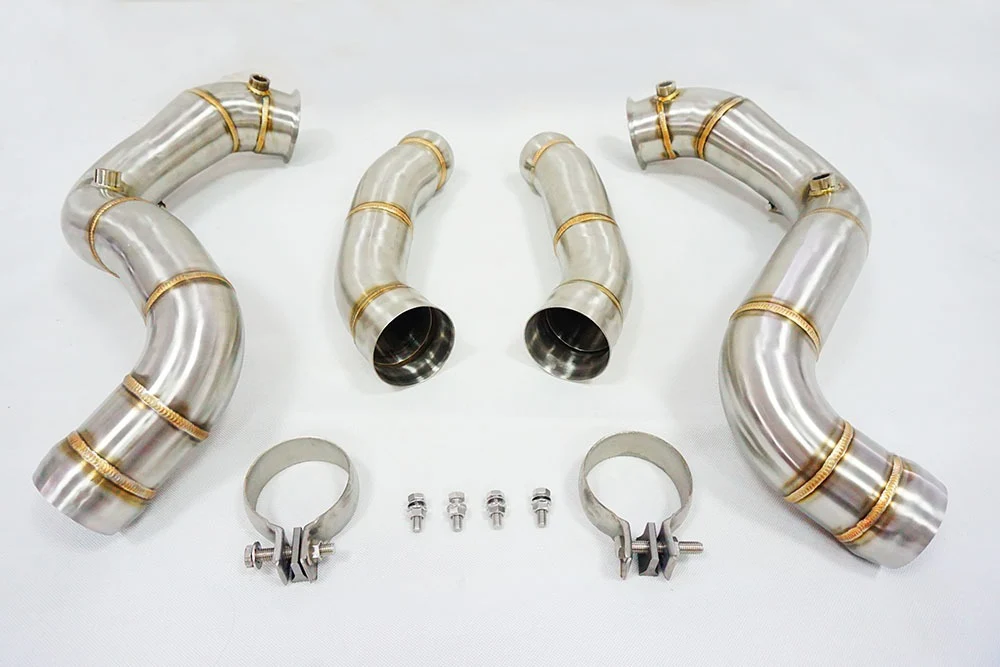
There’s something special about driving a Mercedes-AMG. The power is obvious, but it’s the way that power arrives that makes these cars memorable. A sharp throttle response, a deep exhaust note, and the feeling that the engine has plenty more to give — that’s what enthusiasts chase. For many owners, upgrading the exhaust system is one of the first steps toward making the car feel more personal. Downpipes, in particular, can have a noticeable effect on sound, exhaust flow, and overall performance.
Still, choosing the right setup isn’t simply a matter of buying the loudest option available. Different AMG engines and models have different requirements, and the choice between catted and catless systems can change the character of the car quite dramatically.
Why Downpipes Matter
Downpipes sit close to the engine and play an important role in carrying exhaust gases away from the turbochargers. From the factory, they are designed around a balance of emissions compliance, noise control, reliability, and everyday drivability. That makes sense for a mass-produced performance car, but enthusiasts sometimes want something more aggressive.
An upgraded downpipe can improve exhaust gas flow by reducing restrictions in the system. Depending on the vehicle and supporting modifications, this may contribute to better turbo response and increased power potential. Just as importantly, it can change the exhaust tone. The car may sound deeper, sharper, and more energetic when the throttle is opened.
Of course, results vary. A downpipe isn’t a magic horsepower button. The rest of the exhaust system, engine software, fuel quality, and overall condition of the car all matter.
Catted or Catless? The C63 W205 Question
The Mercedes-AMG C63 W205 is already a seriously capable machine, and its twin-turbo V8 gives owners plenty of reasons to modify it. When shopping for mercedes c63 w205 catted and catless downpipes , the biggest decision usually comes down to the intended use of the vehicle.
Catted downpipes use high-flow catalytic converters that maintain emissions-control functionality while allowing better exhaust flow than many restrictive factory components. They’re generally the more sensible choice for drivers who use their AMG regularly and still want a reasonable balance between performance, sound, and comfort.
Catless versions remove the catalytic converters altogether. This can create a much more aggressive exhaust note and reduce restriction, but there are trade-offs. Emissions compliance, exhaust smell, warning lights, and local road regulations all need to be considered before making the change.
The A45 S: Small Car, Serious Potential
The Mercedes-AMG A45 S proves that performance doesn’t require a huge engine. Its turbocharged four-cylinder has become well known for producing impressive power from relatively little displacement. Because the turbocharger works hard, exhaust flow becomes an important consideration when modifying the car.
An aftermarket mercedes a45s decat downpipe is often chosen by enthusiasts looking for a louder, more aggressive exhaust character and less restriction ahead of the rest of the system. It can also complement other performance modifications, particularly when the owner is building a more comprehensive setup rather than changing one component in isolation.
But again, there’s no need to rush. A daily-driven A45 S can become tiring if the exhaust is excessively loud or produces unwanted drone. The best modification is usually the one that makes the car more enjoyable without ruining the reasons you bought it in the first place.
AMG GT Models and Exhaust Character
The AMG GT family has its own personality. Whether you’re looking at a GT, GTR, or GTS, these cars were designed to deliver an emotional driving experience. Exhaust sound is part of that experience, which explains why downpipe upgrades are so popular among owners.
For enthusiasts researching mercedes amg gt gtr gts downpipes , compatibility is particularly important. Different model years, engine configurations, emissions specifications, and exhaust layouts can affect which components are suitable. A downpipe that fits one AMG GT variant shouldn’t automatically be assumed to fit another.
This is where careful research pays off. Checking engine specifications, model year, turbo configuration, flange design, sensor locations, and available tuning support before ordering can save plenty of frustration later.
Sound Is Only Half the Story
One of the biggest attractions of downpipes is sound, but performance-minded owners should look beyond the exhaust note. Better exhaust flow can help reduce backpressure and allow turbocharged engines to move gases more efficiently.
That said, louder doesn’t always mean faster. A poorly designed component can create its own problems, while a quality system should be engineered around proper dimensions, smooth transitions, strong welds, and accurate sensor positioning.
Material choice matters too. Stainless steel is popular because it offers durability and resistance to corrosion, while more premium materials can reduce weight and tolerate high temperatures extremely well. Build quality often matters more than flashy marketing claims.
Think About the Whole Setup
A downpipe upgrade works best when considered as part of the entire vehicle. If you’re already running an aftermarket exhaust, intake, intercooler, or ECU calibration, the components need to work together.
Software is especially important on modern turbocharged AMGs. Changes to exhaust flow can alter how the engine behaves, and some setups may require suitable ECU calibration to take full advantage of the hardware. It’s worth speaking with a reputable tuner who understands the specific AMG platform rather than relying on a generic map.
And don’t forget maintenance. Modified cars deserve regular inspections, particularly around exhaust joints, oxygen sensors, clamps, and heat-sensitive components.
Making the Right Choice
There isn’t one perfect downpipe for every Mercedes-AMG owner. Someone building a weekend performance car may happily accept a louder and more aggressive setup. A driver covering thousands of kilometres every year might prefer something quieter and more practical.
Before buying, think about how you actually use your car. Consider local emissions and noise regulations, desired sound level, tuning plans, daily comfort, installation quality, and long-term reliability. Those details may not sound exciting, but they’re what separate a satisfying modification from an expensive headache.
Final Thoughts
Mercedes-AMG cars already deliver a remarkable combination of luxury and performance. Downpipe upgrades can push that personality further, giving the engine a more expressive voice while potentially improving exhaust flow and performance potential.
The trick is choosing intelligently. Quality construction, correct fitment, sensible supporting modifications, and professional installation are all more important than simply chasing the most aggressive specification.
After all, modifying an AMG should make you smile every time you start the engine — not make you wonder why you changed it in the first place.
